


DESI Concludes Mission, Unveiling Unprecedented 3D Cosmic Map and Dark Energy Insights
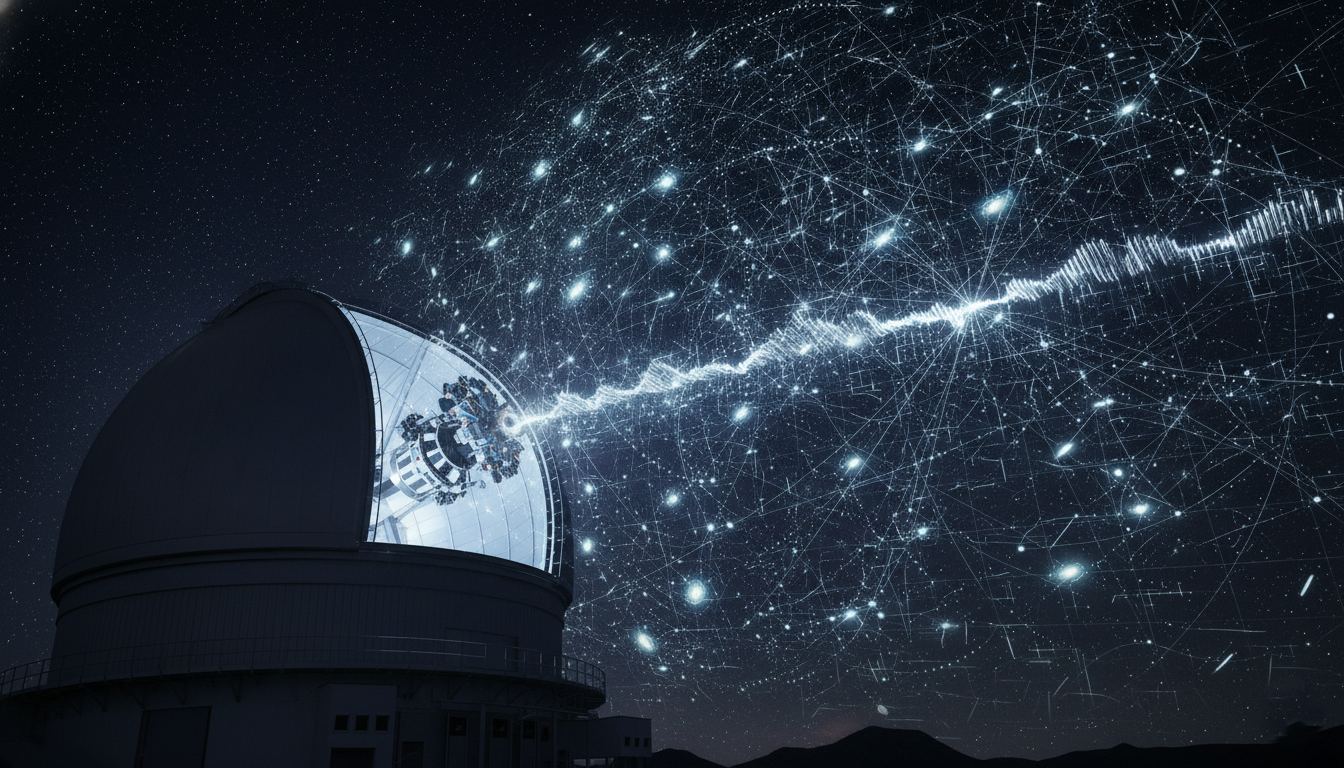
The Dark Energy Spectroscopic Instrument (DESI) has officially concluded its primary five-year operational phase, marking a monumental achievement in observational cosmology. This ambitious endeavor has successfully constructed the most expansive and intricately detailed three-dimensional map of the universe recorded to date. By meticulously surveying the cosmos, DESI has cataloged an astonishing array of over 47 million galaxies and quasars, providing an unprecedented view into the large-scale structure of the universe across vast cosmic distances.
This comprehensive dataset offers an invaluable foundation for understanding the forces that govern the evolution and expansion of our cosmos. A pivotal preliminary finding emerging from DESI’s extensive data analysis points towards early indications that dark energy, the enigmatic force driving the accelerating expansion of the universe, may not be constant but could in fact evolve over cosmic time. This observation represents a significant departure from prevailing cosmological models, which often assume dark energy to possess a static equation of state.
If confirmed through further rigorous analysis, this dynamic characteristic of dark energy could necessitate a fundamental re-evaluation of established principles concerning the universe's genesis, its ongoing development, and its ultimate destiny. The methodology employed by DESI involved utilizing a sophisticated array of 5,000 robotic fiber-optic positioners, precisely aimed at thousands of celestial objects simultaneously. By capturing and analyzing the spectra of light emitted from distant galaxies and quasars, DESI precisely measured their redshifts.
These redshift measurements are crucial for determining the distances to these cosmic entities, thereby enabling the reconstruction of the universe's three-dimensional architecture. This intricate process allowed scientists to chart the distribution of matter and energy with unparalleled precision, revealing the delicate cosmic web that permeates the observable universe. The sheer volume and quality of data collected over the mission’s duration underscore the technological and scientific prowess behind this groundbreaking instrument.

OctaSend - Professional Email Marketing Platform
OctaSend is a professional email marketing platform that helps businesses create, send, and track powerful campaigns with ease. Featuring smart automation, advanced analytics, and...

Ultrazn - Powerful Cloud Hosting for Your Digital Success
Ultrazn offers a complete digital solution with reliable domain registration, high-performance cloud hosting, secure business email, and scalable infrastructure. Designed for speed...

TradExcel - Professional Trading Journal
TradExcel is a professional trading journal built to help traders log, analyze, and revisit every trade. By tracking performance, strategies, and discipline, TradExcel empowers tra...
The implications of a potentially evolving dark energy are profound, extending far beyond the realm of theoretical astrophysics. Such a discovery would not only compel a fundamental rewrite of our current cosmological models but also challenge our understanding of fundamental physics, potentially requiring new theories beyond the standard model of particle physics and general relativity. It would reshape our perspectives on the universe’s earliest moments, influencing theories of inflation and the distribution of primordial matter.
Furthermore, a dynamic dark energy would dramatically alter predictions for the universe's eventual fate, from scenarios like the Big Rip or Big Crunch to the Big Freeze, introducing new complexities and possibilities into the cosmic narrative. While these initial findings from DESI are compelling, they are presented as early hints, necessitating further validation and extensive peer review. The ongoing analysis of the vast dataset gathered by DESI is expected to yield even more insights as scientists delve deeper into its intricacies.
This mission’s successful completion and its initial groundbreaking results firmly establish DESI as a cornerstone for future cosmological research, providing a rich repository of data that will continue to inform and inspire generations of astronomers and physicists as they strive to unravel the universe's deepest mysteries. The insights gleaned from this cosmic map will undoubtedly serve as a critical benchmark for all subsequent explorations into the nature of dark energy and the ultimate structure of spacetime.
Ultrazn - Powerful Cloud Hosting for Your Digital Success
Ultrazn offers a complete digital solution with reliable domain registration, high-performance cloud hosting, secure business email, and scalable infrastructure. Designed for speed...
TradExcel - Professional Trading Journal
TradExcel is a professional trading journal built to help traders log, analyze, and revisit every trade. By tracking performance, strategies, and discipline, TradExcel empowers tra...
OctaSend - Professional Email Marketing Platform
OctaSend is a professional email marketing platform that helps businesses create, send, and track powerful campaigns with ease. Featuring smart automation, advanced analytics, and...
Comments (0)
Leave a Comment
No comments yet. Be the first to comment!
Related Posts



OctaSend - Professional Email Marketing Platform
OctaSend is a professional email marketing platform that helps businesses create, send, and track powerful campaigns with ease. Featuring smart automation, advanced analytics, and...
TradExcel - Professional Trading Journal
TradExcel is a professional trading journal built to help traders log, analyze, and revisit every trade. By tracking performance, strategies, and discipline, TradExcel empowers tra...
Ultrazn - Powerful Cloud Hosting for Your Digital Success
Ultrazn offers a complete digital solution with reliable domain registration, high-performance cloud hosting, secure business email, and scalable infrastructure. Designed for speed...